
Call for Applications: Ranjeet Bhagwan Singh (RBS) Grant 2026
January 20, 2026
ASM Reinforces Its Role in Science and Innovation
February 13, 2026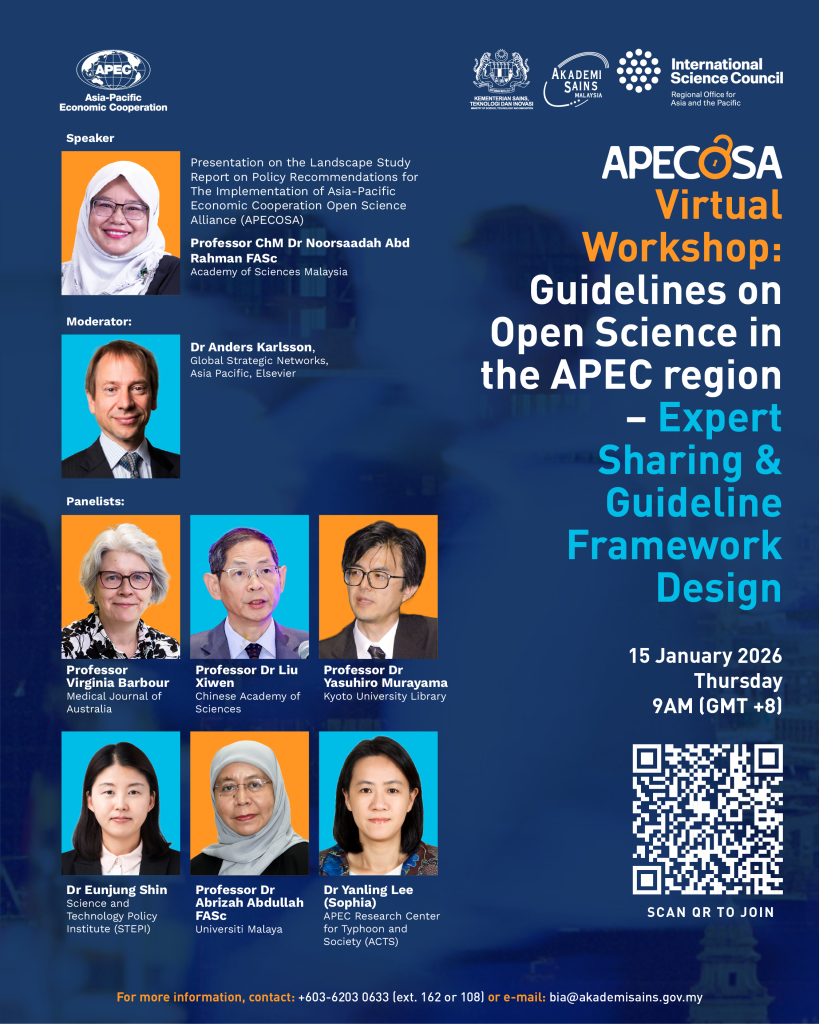
APEC economies are gradually progressing toward a common objective of strengthening cooperation in open science. This direction was discussed during the recent APECOSA Virtual Workshop: Guidelines on Open Science in the APEC Region, where participants reviewed current initiatives and considered possible areas for regional coordination.
A total of 62 participants joined the workshop, representing 15 APEC economies, highlighting the broad regional interest and commitment to advancing open science to enhance research collaboration, transparency, and accessibility.
At present, 16 of the 21 APEC economies have established open science or related initiatives. These include Australia’s Research Data Commons, Canada’s Open Science Action Plan, Malaysia’s Open Science Platform, and China’s national open access and data-sharing efforts.
Despite these developments, participants noted that implementation remains uneven across economies.
Several shared challenges were identified, including limited awareness of open science practices, differences in infrastructure maturity, funding constraints, skills shortages, and concerns regarding data governance and trust.
In response, the concept of an APEC Open Science Alliance was discussed as a mechanism to improve policy alignment, governance structures, and technical interoperability across economies.
Capacity building was highlighted as a key consideration, particularly in relation to training data stewards and curators to support appropriate data management practices and adherence to FAIR principles.
Discussions emphasised the practical role of open science in supporting research collaboration and addressing shared regional challenges.
Examples included disaster risk research and food security studies that could benefit from greater data accessibility and reuse across economies.
Survey results presented at the workshop indicated that policy alignment, ethics and security considerations, data management standards, and incentive structures were viewed as priority areas for developing APEC-wide guidance.
Participants also expressed support for the longer-term development of an APEC Open Science Platform, potentially preceded by a basic knowledge-sharing portal.
Overall, the workshop reflected a consensus that increased coordination and information sharing could support more consistent adoption of open science practices across the APEC region.
Leadership and Alignment in Open Science Reform
By Professor Virginia Barbour, Declaration on Research Assessment (DORA), Australia
Professor Barbour noted that she was speaking in a personal capacity, including as Co-Chair of the Declaration on Research Assessment (DORA).
She emphasised that Open Science, research assessment and related initiatives should be viewed as a single, interconnected system rather than separate policy agendas.
Australia’s Open Science ecosystem was described as highly distributed, involving national funders, infrastructure bodies, academies, peak bodies and advocacy groups.
Key initiatives include open access mandates by major funders, national publisher negotiations led by university libraries, and coordination of persistent identifiers and FAIR data practices by the Australian Research Data Commons.
Professor Barbour cautioned that poorly aligned incentives in one part of the research system can lead to unintended and harmful effects elsewhere, underscoring DORA’s call for coordinated, system-wide reform.
The National Health and Medical Research Council (NHMRC) was highlighted as a positive example, having integrated responsible research assessment with Open Science principles.
Central to DORA’s work is leadership by influential organisations, particularly funders, supported by empowered champions, national commitments, and investment in implementation and capacity building.
DORA also seeks to raise awareness of responsible research assessment, recognise diverse research outputs and processes, and promote data sharing as a means to strengthen Open Science and research integrity.
Japan’s Open Science Journey: Reflections from Policy and Practice
By Professor Yasuhiro Murayama, Kyoto University, Japan
According to Professor Yasuhiro Murayama, Japan’s approach to Open Science has evolved through close interaction among researchers, research institutions, and policymakers, shaped by both national priorities and sustained engagement in global forums.
Drawing on his experience working across academic, governmental, and international science organisations, Professor Murayama noted that Open Science has long been recognised in Japan as a means of strengthening research quality, data stewardship, and international collaboration.
He highlighted Japan’s active role in G7 science processes, where openness, FAIR data principles, and appropriate incentives for researchers have been repeatedly emphasised.
He explained that these global discussions have informed domestic policy development, including national open science principles, research data policies, and guidelines for trusted data repositories.
Open Science has also been embedded within Japan’s Science, Technology and Innovation Basic Plans, reinforcing its strategic importance to data-driven research and innovation.

(Source: Cabinet Office, Government of Japan)
Professor Murayama observed that progress in Open Science depends not only on policy mandates but also on robust research infrastructures, community-driven standards, and long-term investment in data management and interoperability.
From his perspective, Japan’s experience underscored the value of aligning national action with global frameworks, while remaining attentive to disciplinary diversity and the evolving nature of digital research ecosystems.
Korea’s Experience in Open Science: Reflections and Lessons for APEC
By Dr Eunjung Shin, Science and Technology Policy Institute (STEPI), Republic of Korea
According to Dr Eunjung Shin, the Republic of Korea’s experience with Open Science highlights the importance of coordinated engagement at international, regional, and national levels.
She noted that Korea has actively contributed to global policy development through sustained involvement in UNESCO and OECD open science initiatives, where Korean practices in open science infrastructure have been recognised as international best practices.
Dr Shin explained that domestically, Korea has strengthened its open science ecosystem through the adoption of a national open access declaration, the development of publicly funded research data platforms, and the establishment of institutional arrangements that support research integrity, data sharing, and the responsible use of emerging technologies, such as artificial intelligence.
She added that these measures were particularly important during the COVID-19 pandemic, enabling timely data sharing and regional collaboration.
Reflecting on lessons for APEC economies, Dr Shin emphasised the need for a phased and flexible approach to open science implementation, backed by sustained public investment, trusted digital infrastructure, and aligned incentive systems.
She underscored that capacity building, interoperable standards, and engagement with communities of practice are essential to translating regional guidelines into effective and locally meaningful open science practices.
Open Science Guidelines in the APEC Region: The Core Components
By Professor Dr Abrizah Abdullah. Universiti Malaya, Malaysia
According to Professor Abrizah, effective Open Science guidelines for the APEC region must be both clear in scope and flexible in practice, recognising that openness exists along a spectrum rather than as a single standard.
She proposed a tiered, outcome-oriented approach, beginning with open access to publications, progressing to open data aligned with FAIR principles, and ultimately encompassing open methodologies, code, peer review, and educational resources.
Professor Abrizah emphasised that this progression depends on strong enabling foundations. These include sustained investment in trusted, non-commercial and interoperable repositories, alongside the widespread use of persistent identifiers such as ORCID IDs, DOIs, and institutional identifiers to support reliable discovery and reuse.
She also highlighted the importance of aligning incentives with open science values, noting that recognition in funding decisions, promotion, and research assessment must move beyond journal-based metrics toward meaningful open research contributions.
In her view, clear governance structures, continuous professional development, and equitable publishing models are essential to sustained adoption. Legal and ethical safeguards must balance openness with the protection of sensitive data and knowledge.
Finally, Professor Abrizah underscored the value of shared monitoring and learning across APEC economies to support consistent, responsible, and impactful open science practices.
China’s Policy Framework for Advancing Open Science
By Professor Xiwen Liu, National Science Library, Chinese Academy of Sciences (CAS)
According to Professor Xiwen Liu, China’s approach to advancing Open Science reflects a steadily evolving policy framework that integrates national legislation, institutional practices, and international cooperation.
He noted that this commitment was clearly demonstrated in 2021, when Open Science was formally incorporated into the Law on Scientific and Technological Progress, anchoring openness within the country’s long-term science and innovation strategy.
Professor Liu explained that since 2014, coordinated efforts have significantly expanded access to research publications through a combination of gold open access publishing, institutional repositories, and preprint platforms, supported by research funders, libraries, and international initiatives.
Alongside this, major research infrastructures and large‑scale scientific instruments have been progressively opened to both domestic and international users, enabled by centralised coordination and multi‑level policy implementation.
He further highlighted that China has strengthened scientific data governance through national regulations and institutional measures that emphasise responsible and sustainable data sharing.
In his view, capacity building remains central, supported by training programmes, open educational resources, and practical guidance across the research lifecycle.
Professor Liu also pointed to a recent growth of international engagement through dedicated action plans and the “Open for Science 10” initiative under UNESCO’s Science Decade, positioning Open Science as a platform for global collaboration and inclusive knowledge sharing.
Open Science, Resilience, and Regional Collaboration in APEC
By Dr Yanling Lee (Sophia), APEC Resilience City and Community Initiative
According to Dr Yanling Lee, Open Science plays a critical enabling role in strengthening resilience across APEC economies, particularly in disaster preparedness, emergency response, and sustainable development.
Speaking in the context of the APEC Resilience Week and the APEC Open Science Alliance (APECOSA), she emphasised that shared scientific knowledge, open data, and cross-border collaboration are essential to addressing complex, evolving risks, including climate-related disasters and extreme weather events.
Dr Lee highlighted how open science and open innovation support the integration of advanced technologies such as artificial intelligence, big data, cloud computing, and smart infrastructure, enabling more timely decision-making and people-centred early warning systems.
She also underscored the importance of public–private partnerships and cross-fora collaboration in translating policy commitments into practical, local solutions that draw on scientific, indigenous, and community knowledge.
In her view, initiatives under APECOSA provide a collaborative platform to connect economies, strengthen capacity building, and promote interoperable science and technology systems.
By embedding open science into resilience‑oriented strategies, Dr Lee argued that APEC economies can collectively enhance human security, accelerate recovery, and build more inclusive and sustainable communities.