
Factsheet: National Planetary Health Action Plan (NPHAP)
January 9, 2026
ASM Signs MoA with Sarawak on Sustainable Mineral Industry Policy
January 15, 2026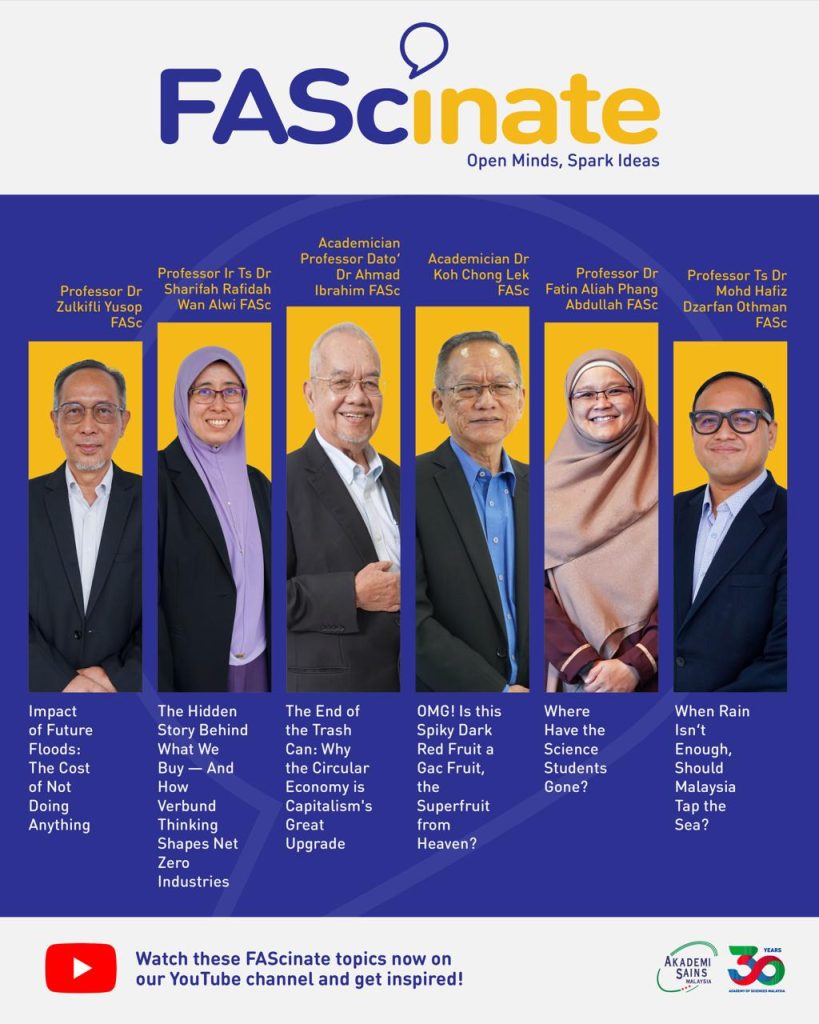
Be inspired by a series of science talks delivered by esteemed speakers from the ASM Expert Network. In this series of ASM FAScinate, exploring compelling topics such as future floods, seawater, superfruits, science education, Net Zero industries and the circular economy.
OMG! Is this Spiky Dark Red Fruit a Gac Fruit, the Superfruit from Heaven?
Often overlooked in global markets, the Gac fruit (Momordica cochinchinensis) is native to Southeast Asia and is easily recognised by its spiky, dark red skin when ripe.
Beyond its striking appearance lies an exceptional concentration of vitamins and bioactive compounds essential for eye, skin, and overall health.
Academician Dr Koh Chong Lek FASc, a multi-award-winning scientist, shared very useful facts about the Gac fruit and its various health benefits.
Dr Koh explained that the Gac fruit contains an extraordinary range of carotenoids, including lycopene, beta-carotene, lutein, and zeaxanthin, as well as vitamins C and E, essential fatty acids, and important minerals.
Research published by the United States Department of Agriculture revealed that the Gac fruit contains up to 70 times more lycopene than tomatoes and 10 times more beta-carotene than carrots per gram of fresh weight, making it one of the richest known natural sources of antioxidants.
These bioactive compounds help neutralise harmful free radicals, reduce oxidative stress, and activate protective cellular pathways that support eye, skin, immune, and cardiovascular health.
Dr Koh highlighted lycopene’s role in activating the Nrf2 pathway, which enhances the body’s natural antioxidant and detoxification systems.
Scientific studies have linked the Gac fruit to a wide range of potential health benefits, including anti-inflammatory, pro-vitamin A, antimicrobial, and immunomodulatory effects. Its benefits extend to eye health, brain function, gut health, and protection against chronic diseases.
Often called the “Fruit from Heaven,” the Gac fruit remains underappreciated worldwide. Dr Koh emphasised that greater awareness could unlock its potential as a valuable functional food for healthier living.
The Hidden Story Behind What We Buy and How Verbund Thinking Shapes Net Zero Industries
Professor Ir Ts Dr Sharifah Rafidah Wan Alwi FASc from the Faculty of Chemical and Energy Engineering, Universiti Teknologi Malaysia (UTM), challenged us to rethink what lies behind the everyday products we use. In her talk, she reminded the audience that the product we purchase represents only the final 5% of a much larger story.
Behind a “simple” item such as a bottle of cooking oil are plantations, factories, energy-intensive processes, logistics, chemical reactions, and significant amounts of waste generated at every stage.
Using the palm oil industry as an example, she highlighted that producing 1 tonne of crude palm oil generates up to 3.5 tonnes of wastewater, along with solid waste and greenhouse gases such as methane, which is more potent than carbon dioxide.
Combined with rising consumer waste, Malaysia faces an urgent challenge: how to reduce emissions while sustaining industrial growth.
Dr Sharifah stated that the problem does not lie with individual factories, but with how industrial systems are designed. Many plants operate in isolation, duplicating resources and discarding valuable by-products.
The solution, she explained, lies in industrial symbiosis or Verbund thinking. Industrial symbiosis is a system in which industries are designed as integrated ecosystems.
In such systems, waste heat, water, materials, and even carbon dioxide from one plant become useful inputs for another.
She showcased successful global examples of Verbund systems. She also highlighted UTM’s pioneering Verbund Plant Design Project, which trains students to design integrated industrial parks rather than isolated factories.
Through this approach, future engineers learn systems thinking, resource integration, and low-carbon design—skills essential for achieving Malaysia’s net-zero ambitions.
Her message was clear: net zero cannot be achieved by building isolated plants and factories. It requires collaboration, integration, and a fundamental redesign of how industries work, starting with how we educate the next generation of engineers.
The End of the Trash Can: Why the Circular Economy is Capitalism’s Great Upgrade
Academician Professor Dato’ Dr Ahmad Ibrahim FASc, a distinguished Malaysian academic and industry leader, highlighted the urgent need to transform how economies manage resources to address escalating global challenges.
He identified two major concerns shaping the world today: climate change and population growth. Climate-related events such as floods and landslides are occurring with increasing frequency, disrupting agriculture, food security, and economic stability.
At the same time, a global population exceeding eight billioncontinues to intensify demand for water, energy, food, and critical minerals, placing unprecedented pressure on finite resources.
Professor Dato’ Dr Ahmad explained that the prevailing linear economic model based on extracting resources, producing goods, and discarding waste is no longer sustainable. Waste has become a significant environmental and economic burden, underscoring the need for a new approach.
The circular economy offers such an alternative by keeping resources in use for as long as possible, redesigning systems to minimise waste, and ensuring long-term sustainability for future generations.
While many countries have begun adopting circular economy principles, implementation remains challenging.
Professor Dato’ Dr Ahmad is involved in developing Malaysia’s circular economy framework with the Ungku Aziz Centre at Universiti Malaya for the Ministry of Economy.
The framework emphasised the importance of rethinking product design and business models. He cited examples from the automotive and manufacturing sectors, where durable, repairable, and recyclable products can significantly reduce resource strain.
He also highlighted the role of Extended Producer Responsibility (EPR), particularly in addressing plastic pollution.
Under EPR, producers are responsible for managing products throughout their life cycle, including collection and recycling through systems such as reverse logistics. Effective implementation, he noted, must also integrate existing independent waste collectors.
For Malaysia, embracing the circular economy is essential. As an export- and investment-driven economy, alignment with global sustainability, decarbonisation, and circular economy standards is increasingly critical.
Initiatives such as the voluntary carbon market under Bursa Malaysia reflect early steps in this direction.
Professor Dato’ Dr Ahmad concluded that progress in the circular economy comes through practice and experience. By implementing and continuously improving circular frameworks, Malaysia can strengthen economic resilience while safeguarding environmental sustainability.
When Rain Isn’t Enough, Should Malaysia Tap the Sea?
When we hold a simple glass of water, it is easy to forget how precious it truly is. Although Earth appears blue from space, less than 1% of its water is fresh and accessible for human use.
This reality makes water security a growing concern, even for countries like Malaysia that are blessed with abundant rainfall.
While much of the country enjoys a reliable supply, islands, remote villages, and parts of East Malaysia still face challenges due to difficult terrain and limited infrastructure.
Overreliance on groundwater, as in limestone-rich areas such as Langkawi, can also pose environmental risks, including land subsidence. These challenges invite us to look beyond rivers and rainfall and look towards the sea.
Desalination offers a strategic safety net. Conventional approaches include membrane-based reverse osmosis (RO) and thermal methods, both widely used globally.
While RO is energy-efficient and scalable, it is susceptible to membrane fouling and has high operational costs. Thermal methods are robust and reliable, especially when coupled with waste heat, though they require more space and energy.
At UTM’s Advanced Membrane Technology Research Centre (AMTEC), Professor Ts Dr Mohd Hafiz Dzarfan Othman FASc and his team are advancing next-generation solutions through membrane distillation (MD).
This hybrid technology combines heat and membrane science, using specially engineered omniphobic membranes that resist wetting and contamination.
By integrating solar-driven and photothermal approaches, the team has demonstrated significant reductions in energy consumption.
Desalination should not replace surface water sources but rather strengthen Malaysia’s water resilience — particularly in islands, remote communities, and coastal regions during dry seasons.
With thoughtful design, renewable energy integration, and economies of scale, turning seawater into fresh water can become a responsible and sustainable choice for the nation’s future.
Where Have the Science Students Gone?
Professor Dr Fatin Aliah Phang Abdullah FASc, a Professor at the Faculty of Educational Sciences and Technology, Universiti Teknologi Malaysia (UTM), addressed a critical concern facing Malaysia’s education system: the steady decline in student enrolment in the science stream.
Contrary to popular belief, she argued that the issue is not a lack of interest in science but a growing lack of confidence in learning it.
Drawing on data from international assessments such as the Trends in International Mathematics and Science Study (TIMSS), Professor Fatin highlighted a troubling pattern.
While Malaysian students consistently report a strong interest in science, their confidence in understanding and performing well in science has sharply declined since 2007.
This drop in confidence closely mirrors the fall in science stream enrolment, which stood at only 38.8% of Form 4 students in 2024, far below the long-standing national target of 60%.
Professor Fatin explained that confidence is shaped largely by classroom experiences.
When science is taught through excessive explanation and memorisation rather than exploration and problem-solving, students struggle to internalise concepts and begin to believe that science is “too difficult.”
This perception is often reinforced by parents and teachers, further discouraging students from choosing science.
She emphasised that effective science learning requires students to do science through inquiry, experimentation, and reasoning, which is supported by teaching approaches such as problem-based, project-based, and inquiry-based learning.
However, she noted that many teachers lack sufficient training to implement these methods effectively.
To address this, Professor Fatin called for greater investment in sustained in-service teacher training and coaching, rather than short-term programmes or public STEM events.
She concluded that strengthening teachers’ pedagogical skills is the right investment to rebuild students’ confidence and secure the future of science education in Malaysia.
Impact of Future Floods: The Cost of Not Doing Anything
Professor Dr Zulkifli Yusop FASc, a Professor of environmental hydrology at UTM, highlighted the urgent need for early investment in flood mitigation.
Climate change, sea-level rise, and rapid development are intensifying flood risks, making inaction today far costlier in the future.
Many assume that a “100-year flood” occurs only once every 100 years, or that an area is safe simply because it has never flooded before.
In his talk, Professor Dr Zulkifli challenged these assumptions and highlighted why floods remain Malaysia’s most damaging natural disaster.
About 10.1% of Malaysia’s land area is flood-prone, affecting nearly six million people. Floods account for more than 60% of the country’s disaster events, with total losses far exceeding those from other hazards.
Annual flood damages average around RM900 million, and extreme events have caused losses of several billion ringgit in a single episode.
Malaysia experiences four main types of flooding: flash floods, river floods, coastal floods, and stagnant floods. Flash floods, which account for the majority of cases, develop rapidly due to intense rainfall, urbanisation, clogged drainage systems, and impervious surfaces.
River floods and stagnant floods tend to last longer and cause more serious and widespread damage, as seen in events such as the 2014 Kelantan floods and the 2021 Taman Sri Muda disaster.
Urban development and climate change are expected to worsen future flood risks. Increased rainfall intensity, rising sea levels, and more unpredictable weather patterns mean that past flood records can no longer reliably predict future events.
As a result, flood-mitigation infrastructure must be redesigned to withstand more extreme conditions.
While Malaysia has increased its flood mitigation budget in recent years, studies show that investing in flood adaptation is far more cost-effective than inaction.
Strategic investments could reduce flood-related economic losses by up to 40%, thereby significantly lowering long-term economic and social damage.
The key message is clear: floods are becoming more frequent and severe, and proactive investment in flood adaptation is essential to protect lives, livelihoods, and national development.