

ASM Explores Collaboration with Concordia University
February 13, 2026
ASM Podcast: Ask A Scientist Istimewa Ramadan
March 19, 2026
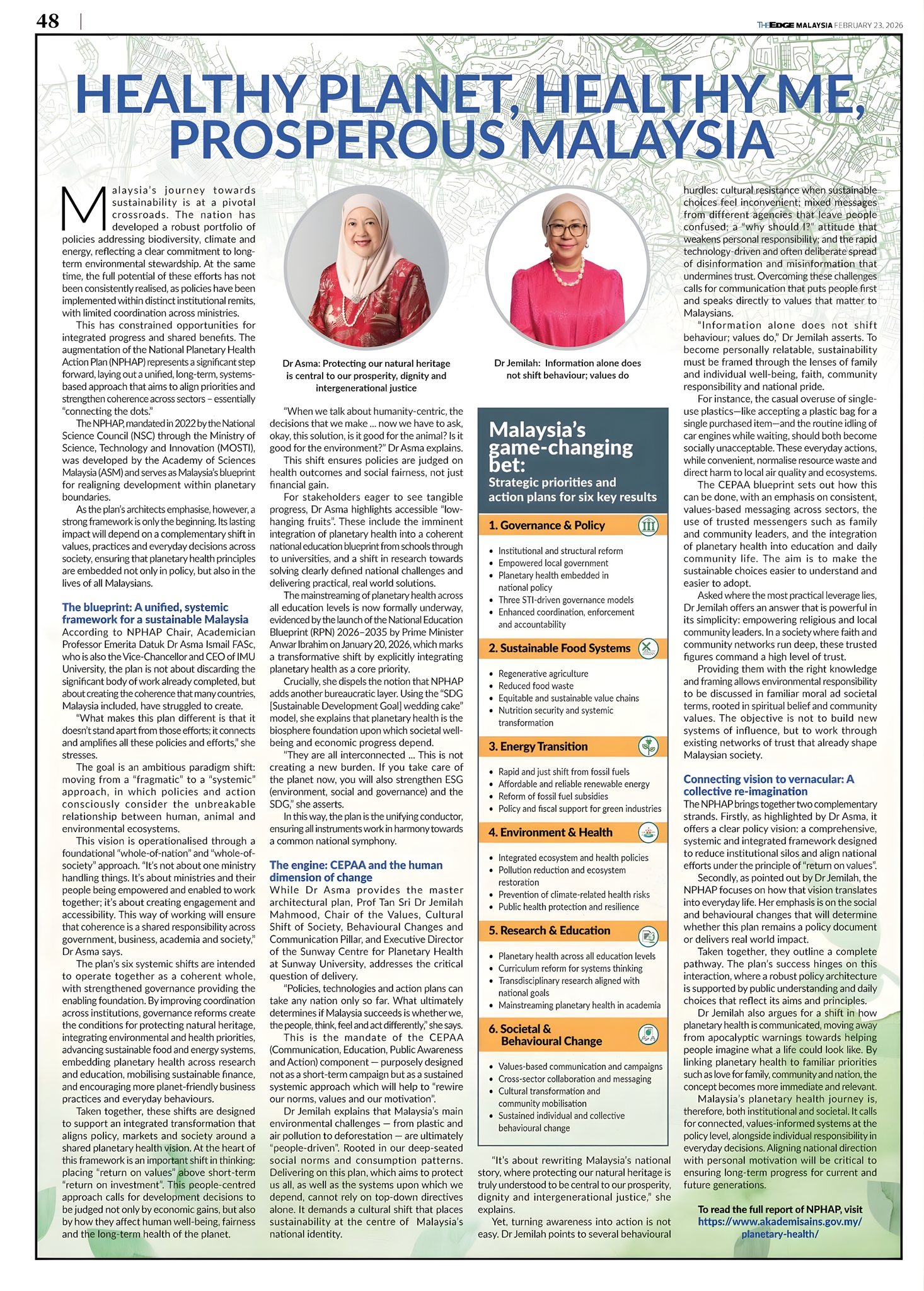
“The country stands at a pivotal moment in its sustainability journey.” – A reality brought into sharp focus by The Edge’s special coverage on the National Planetary Health Action Plan (NPHAP).
With a strong foundation of policies already in place across biodiversity, climate and energy, Malaysia is now pressing forward with a renewed focus on coherence and coordination through the NPHAP.
Developed by ASM, the NPHAP offers a unified, long-term framework designed to align government, industry, educators and communities around a shared vision of planetary health.
As NPHAP Chair Academician Professor Emerita Datuk Dr Asma Ismail FASc explained, “What makes this plan different is that it doesn’t stand apart from those efforts; it connects and amplifies all these policies and efforts.”
Central to the plan is a decisive move away from fragmented, siloed efforts towards a systemic approach that recognises the inseparable link between environmental wellbeing and human wellbeing.
This transformation is grounded in strengthened governance, sustainable food and energy systems, integrated health policies, education reform and values-driven communication.
“It’s not about one ministry handling things,” Dr Asma emphasised. “It’s about ministries and their people being empowered and enabled to work together.”
Beyond policy reform, the NPHAP also underscores the importance of cultural and behavioural change.
According to Professor Tan Sri Dr Jemilah Mahmood, who leads the Values, Cultural Shift and Behavioural Change pillar, lasting impact depends on people as much as institutions. “Policies, technologies and action plans can take any nation only so far. What ultimately determines success is whether we, the people, think, feel and act differently,” she said.
The plan calls on Malaysians to internalise sustainability as part of everyday life and national identity. “Information alone does not shift behaviour; values do,” Dr Jemilah notes, stressing the need to frame planetary health through shared priorities such as family, community, faith and national pride.
Ultimately, as reflected in The Edge’s special coverage, the NPHAP advances a new national narrative, which is rooted in responsibility, fairness and intergenerational justice.
The NPHAP champions a future where environmental stewardship is not treated as a regulatory obligation, but as a shared expression of collective wellbeing.
In Dr Asma’s words, “Protecting our natural heritage is central to our prosperity, dignity and intergenerational justice.”
Peruse the full article via the image below.
Visit the ASM Website to access the executive summary and full report of NPHAP.