
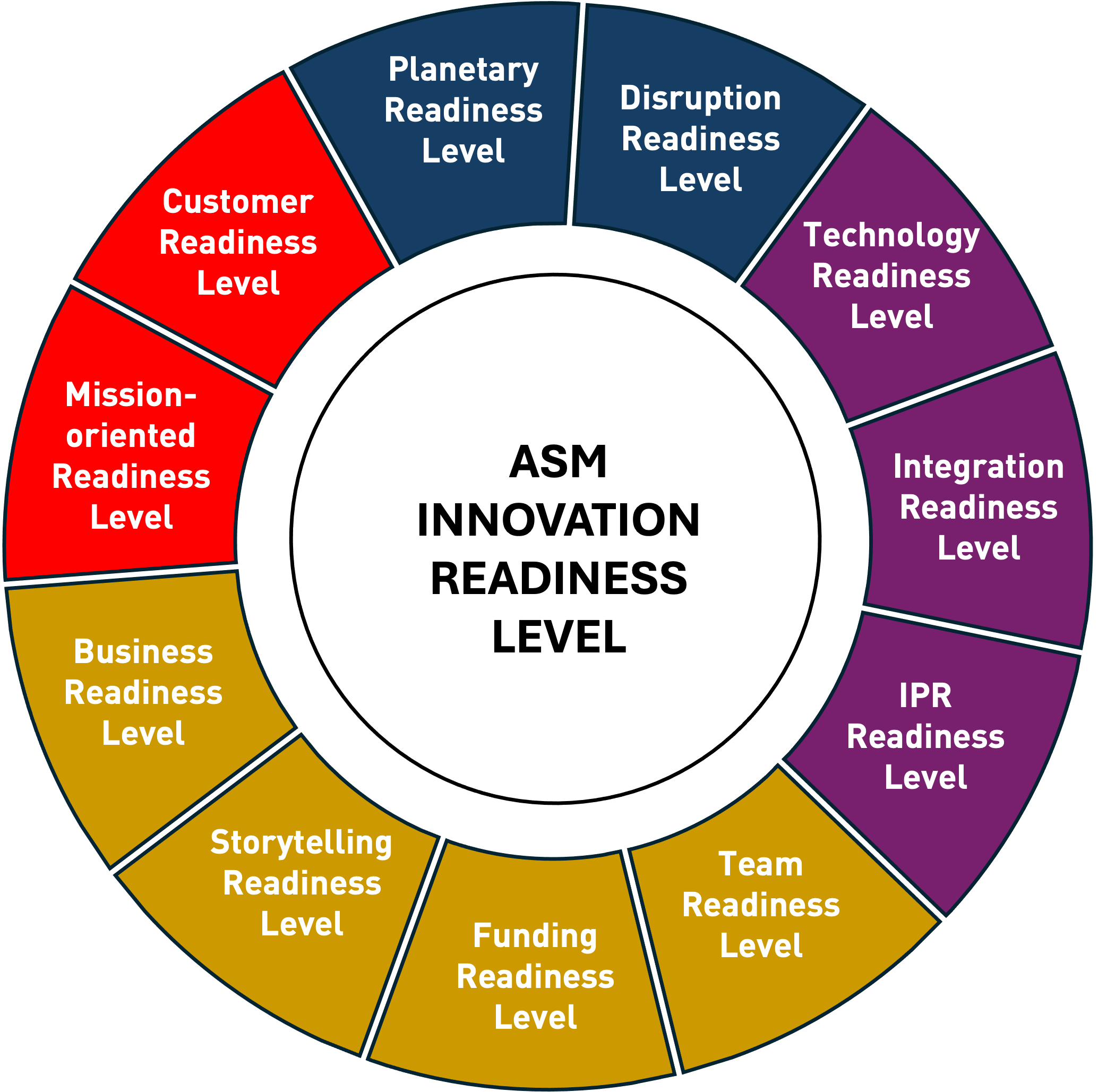
Innovation Readiness is best understood through a set of interrelated dimensions that capture the full ecosystem required to move ideas from conception to impactful outcomes. While Technology Readiness Level (TRL) assesses technical maturity, it is only one part of the bigger picture. The following dimensions broaden the scope, ensuring that innovations are not only technically feasible but also strategically viable, socially relevant, and globally competitive.
Most evaluations focus primarily on project feasibility, cost, potential impact, and novelty. However, a more holistic assessment requires expanding the scope to include additional dimensions that capture the broader ecosystem necessary for innovation success.
The Innovation Readiness Level (IRL) is adapted from the KTH Innovation Readiness Level developed by the KTH Royal Institute of Technology, Sweden. The original framework was designed to help innovators and start-ups assess and advance their innovation journey across six key dimensions of readiness: Technology, Business, Intellectual Property Rights (IPR), Team, Funding, and Customer.
Building upon this foundation, the Academy of Sciences Malaysia (ASM) has expanded and refined the model to serve as a comprehensive framework for the evaluation and monitoring of R&D projects. Five additional dimensions were introduced, collectively referred to as the ASM PlaSMID model. PlaSMID is an acronym representing dimensions on Planetary, Storytelling, Mission-Oriented, Integration, and Disruption.
What is the current stage of your technology, and how close is it to real-world application?
| TRL | Description |
| TRL 9 | Actual technology system proven in operational environment |
| TRL 8 | Actual technology system completed and qualified through test and demonstration |
| TRL 7 | Technology prototype demonstration in operational environment |
| TRL 6 | Technology demonstration in a relevant environment |
| TRL 5 | Technology validation in relevant environment |
| TRL 4 | Technology validation in laboratory |
| TRL 3 | Analytical and experimental proof-of-concept of critical function and/or characteristics |
| TRL 2 | Technology concept and/or application formulated |
| TRL 1 | Basic principles observed |
© 2025 Academy of Sciences Malaysia. Licensed under CC BY-NC-SA 4.0
How easily can your technology be integrated into existing systems, infrastructures, or platforms?
| InRL | Description |
| InRL 9 | The project sets new benchmarks for integrating multidisciplinary technologies towards mission goals. |
| InRL 8 | Systems operate fully together in mission scenarios, showing seamless multidisciplinary collaboration and benefits. |
| InRL 7 | Systems, workflows, and teams are aligned for real-world joint operation under mission conditions. |
| InRL 6 | Multidisciplinary systems function together effectively, with performance optimisation across domains. |
| InRL 5 | Integrated prototype demonstrating functional interactions between technologies in a relevant environment. |
| InRL 4 | Small-scale, controlled environment testing of combined technologies for basic interoperability. |
| InRL 3 | Hypotheses tested on whether multidisciplinary technologies can technically or operationally coexist. |
| InRL 2 | Basic mapping of how different technologies might fit together conceptually. |
| InRL 1 | Early identification that multiple disciplines or technologies could contribute to a shared mission. |
© 2025 Academy of Sciences Malaysia. Licensed under CC BY-NC-SA 4.0
How well protected and strategically positioned is your intellectual property (IP)?
| IPRL | Description |
| IPRRL 9 | Strong IPR support and protection for business. Patent granted in relevant countries and maintained in force. |
| IPRRL 8 | IPR strategy and IP management are fully implemented. More complete assessment of freedom-to-operate. |
| IPRRL 7 | All relevant IPR filed (e.g. additional patents). Patent entry into national/regional phase. |
| IPRRL 6 | IPR/patent strategy implemented and supporting business. Positive response on filed applications, initial assessment of freedom-to-operate (or landscape). |
| IPRRL 5 | Draft of IPR/patent strategy in place to use IPR for business. Filed first complete patent application (or other IP registrations). |
| IPRRL 4 | Confirmed if protection is possible and for what (e.g. patentability). Decided why to protect certain IPR (business relevance). |
| IPRRL 3 | Detailed description of possible key IPR (e.g. invention or code). Initial search of the technical field and existing IPR. |
| IPRRL 2 | Identified different forms of possible IPR that you have. Ownership is clarified, and you clearly own/control IPR. |
| IPRRL 1 | Hypothesising on possible IPR you might have (such as patents, software, copyright, designs, trade secrets, etc.). |
© 2025 Academy of Sciences Malaysia. Licensed under CC BY-NC-SA 4.0
Do you have the right team to successfully deliver this project?
| TeRL | Description |
| TeRL 9 | High performing, well-structured team and organisation that is maintained and performs over time. |
| TeRL 8 | Management and CEO in place. Professional use of board/advisors. Activated plan and recruitment for building long term team. |
| TeRL 7 | Team and culture are fully in place and proactively developed. Updated plan for building necessary team on longer term. |
| TeRL 6 | Complementary, diverse and committed team with all necessary competencies/resources, including both business and tech. |
| TeRL 5 | Initial founding team with main needed competencies. Team agrees on ownership and roles and has aligned goals. |
| TeRL 4 | A champion is present. Several needed competencies in place. Initiated plan for recruiting or securing additional key resources. |
| TeRL 3 | A few of necessary competencies/resources are present. Defined needed competencies/resources (and plan for finding). |
| TeRL 2 | Insight and first idea on necessary competencies or external resources (e.g. partners). |
| TeRL 1 | Little insight into the need for a team (typically an individual). Lack of necessary competencies/resources. |
© 2025 Academy of Sciences Malaysia. Licensed under CC BY-NC-SA 4.0
How will you manage the funds, and do you have a plan for follow-up funding?
| FRL | Description |
| FRL 9 | Investment obtained. Additional investment needs and options are continuously considered. |
| FRL 8 | There is corporate order and structure enabling investment. Term sheet discussions with interested investor(s). |
| FRL 7 | Team presents a solid investment case, including status and plans. Discussions with potential investors are ongoing around an offer. |
| FRL 6 | Improved investor presentation in place, including business/ financials. Decided on seeking private investors, and initial contacts taken. |
| FRL 5 | Investor-oriented presentation and supporting material tested. Applied for and secured additional larger funding (soft or other). |
| FRL 4 | Good pitch and short presentation of the business in place. Plan in place with different funding options over time. |
| FRL 3 | Well-described business concept and initial verification plan. First small soft funding secured. |
| FRL 2 | Description of business concept. Defined funding needs and funding options for initial milestones. |
| FRL 1 | Initial business idea with vague description. No clear view on funding needs and funding options. |
© 2025 Academy of Sciences Malaysia. Licensed under CC BY-NC-SA 4.0
Can you clearly explain your project’s value to non-experts and key stakeholders?
| SRL | Description |
| SRL 9 | Project becomes a recognised model of success; storytelling focuses on transformation, lessons learned, and future potential. |
| SRL 8 | Broader impact is visible across ecosystems, industries, or communities; storytelling links project to systems-level change. |
| SRL 7 | Narrative shifts from “we can” to “we are” — showing real-world adoption examples. |
| SRL 6 | Prototypes or trials generate measurable, credible impact data; storytelling backed with evidence. |
| SRL 5 | Early users, testers, or partners start validating the impact story informally. |
| SRL 4 | Early lab or controlled environment results show signals of impact; initial success cases. |
| SRL 3 | Draft scenarios show possible positive outcomes, backed by preliminary assumptions. |
| SRL 2 | Rough narrative of who might benefit and how; still theoretical. |
| SRL 1 | Early-stage speculation about potential benefits; no real-world connection yet. |
© 2025 Academy of Sciences Malaysia. Licensed under CC BY-NC-SA 4.0
What is your plan to bring this product or technology to market?
| BRL | Description |
| BRL 9 | Business model is final and is scaling with growing recurring revenues that result in a profitable and sustainable business. |
| BRL 8 | Sales and metrics show business model holds and can scale. Business model is fine-tuned to explore more revenue options. |
| BRL 7 | Product/market fit, and customers’ payment willingness demonstrated. Attractive revenue vs cost projections (validated by data and sales). |
| BRL 6 | Full business model, including pricing verified on customers (by test sales). |
| BRL 5 | Parts of business model tested on market, and canvas updated. First version of revenue model, including pricing hypotheses. Verified competitive position/ uniqueness through market feedback. |
| BRL 4 | First version of full business model in canvas, including revenues/costs. First projections to show economic viability and market potential. |
| BRL 3 | Draft of business model in canvas, excluding revenues/costs. Described market potential and complete competitive overview. |
| BRL 2 | First possible business concept described. Identified overall market and some competitors/alternatives. |
| BRL 1 | Hypothesising on possible business concept. Little knowledge or insight into market and competition. |
© 2025 Academy of Sciences Malaysia. Licensed under CC BY-NC-SA 4.0
Who are your intended customers or end users, and how do you know they need this solution?
| CRL | Description |
| CRL 9 | Widespread product sales that scale. |
| CRL 8 | First products sold and increased structured sales efforts. |
| CRL 7 | Customers in extended product testing or first test sales. |
| CRL 6 | Benefits of the product confirmed through partnerships or first customer testing. |
| CRL 5 | Established interest in product and relations with target customers. |
| CRL 4 | Confirmed problem/needs from several customers or users. |
| CRL 3 | First market feedback established. |
| CRL 2 | Identified specific needs in market. |
| CRL 1 | Hypothesising on possible needs in market. |
© 2025 Academy of Sciences Malaysia. Licensed under CC BY-NC-SA 4.0
How aligned is your project to the national/regional/global mission?
| MRL | Description |
| MRL 9 | Fully embedded in national systems and contributing to long-term transformation. |
| MRL 8 | Project contributes to measurable progress on mission KPIs (e.g., CO₂ reduction, national supply security). |
| MRL 7 | Clear plan for pilot/scale-up with alignment to policy instruments (incentives, procurement, regulation). |
| MRL 6 | Integrated into a larger programme or roadmap addressing mission targets. |
| MRL 5 | Project builds partnerships with mission-relevant actors (industry, academia, local government, etc.). |
| MRL 4 | Stakeholders (e.g., ministries, agencies) acknowledge strategic value and alignment. |
| MRL 3 | Early studies or models demonstrate potential impact towards mission objectives. |
| MRL 2 | Clear articulation of how the research fits within a specific mission or national agenda. |
| MRL 1 | Research idea loosely relates to a national strategic direction or grand challenge. |
© 2025 Academy of Sciences Malaysia. Licensed under CC BY-NC-SA 4.0
Does your project have the potential to disrupt or transform current practices or industries? (e.g., new entrants, regulations, shifts in global dynamics)
| DRL | Description |
| DRL 9 | System-wide disruption achieved; new standard or dominant model emerges (e.g., post-disruption normal). |
| DRL 8 | Scaling underway; existing value chains are being rewritten or absorbed; measurable economic/societal impact. |
| DRL 7 | Adoption by early adopters disrupts traditional players, prompting regulators or industry players to respond. |
| DRL 6 | Clear potential to displace or transform part of an industry/process; early market resistance observed. |
| DRL 5 | Demonstrated shift in cost, access, or performance indicators vs incumbents in a pilot or testbed. |
| DRL 4 | Early validation with limited stakeholders showing signs of real-world disruption potential. |
| DRL 3 | Disruption model is validated on a small scale or in simulation (e.g., new business model, value chain shift). |
| DRL 2 | Early hypothesis of disruption; disruptive angle is articulated in concept papers or foresight studies. |
| DRL 1 | Speculative potential — disruptive impact is purely theoretical; no model or use case yet. |
© 2025 Academy of Sciences Malaysia. Licensed under CC BY-NC-SA 4.0
How does your project consider environmental sustainability or minimise negative impact?
| PRL | Description |
| PRL 9 | Recognised as a benchmark for pollution prevention, 3Rs advancement, and ecosystem preservation in the sector. |
| PRL 8 | System validated across industries or real-world sites, showing measurable environmental gains. |
| PRL 7 | Project includes environmental lifecycle assessments (LCAs), circularity models, or regulatory green-compliance systems. |
| PRL 6 | Prototype tested with specific green KPIs (carbon reduction, recyclability, waste minimisation). |
| PRL 5 | Early environmental standards or 3R guidelines are tested in near-real conditions. |
| PRL 4 | Basic environmental tests in lab settings show potential for reduced pollution or better resource use. |
| PRL 3 | Initial environmental benefit assumptions are linked to the technology’s proof of concept. |
| PRL 2 | Rough ideas proposed for how the innovation can support pollution prevention, 3Rs, or ecosystem protection. |
| PRL 1 | Conceptual awareness of possible environmental issues linked to project. |
© 2025 Academy of Sciences Malaysia. Licensed under CC BY-NC-SA 4.0